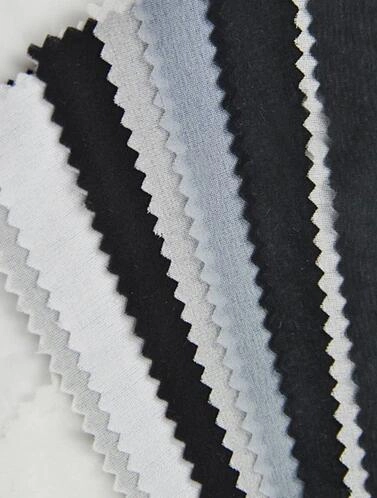
Shirt Interlining Fabrics are used to provide structure, stiffness, and weight to garment components such as collars, bands, and cuffs. They are usually nonwoven fabrics and may be either fusible or sew-on. Fusible interlinings can be applied to both woven and knitted materials, with the most common being cotton domette or flannel. They are normally tested for their durability and compatibility with the shell fabric to ensure they stay bonded during washing and wear.
There are many different types of lining fabric available, depending on the requirements of each garment. For example, muslin and silk charmeuse are often used as a lining for blouses, to add body and weight, with muslin being particularly useful for supporting light fabrics that would otherwise be flyaway. Other lining fabrics include satin and cotton sheeting. These fabrics can also be used for support in heavy-weight fabrics such as denim, corduroy, and gabardine.
For a heavier shirt collar that will require a stiffer, more solid construction, a hard lining or collar lining is required. These linings are generally produced in a warp-knitted tricot or raschel, with various weights being offered to suit the required application. The advantages of these linings are that they have high stability with very little stretch, which is important for a good fit in the human neck and to keep the shape of the collar design intact.
Alternatively, some makers use a floating collar interlining, where the lining is cut to the same shape as the collar, band, or cuff and then sewn to the outer fabric around the edges. This creates a slightly more comfortable collar that is less rigid, but it does lose some of the control you get when using a fused lining. It is also less likely to move within a jacket, which is useful for those who wear their shirts with tailoring.
When selecting an interlining, it is worth bearing in mind the process involved in fusing it to the face fabric as this can have a significant impact on the final quality of the garment. Three key factors need to be considered; temperature, pressure, and time. A balancing of these elements is crucial to ensuring that the fusing will work as intended, and that the garment will have a smooth appearance and be free from bubbles or creases.