Woven interlining for shirts is a structured inner fabric layer bonded or sewn to the shell fabric of a garment to provide shape retention, dimensional stability, and reinforcement in critical areas such as collars, cuffs, plackets, and waistbands. Unlike decorative or outer fabrics, interlining is invisible in the finished garment — yet it fundamentally defines how a shirt looks, feels, and holds its form over years of wear and repeated laundering.
The global shirt manufacturing industry relies on two broad families of interlining: woven and non-woven. Woven interlining — produced on shuttle or shuttleless looms with interlaced warp and weft yarns — delivers superior dimensional stability, drape control, and resistance to delamination compared to its non-woven counterparts. For premium men's dress shirts, formal blouses, and tailored women's shirts, woven interlining is the standard of choice among leading garment factories and fashion brands worldwide.
The Plain Fabric Series 7 from Jiaxing Rainbow (UBL) represents the industry benchmark for lightweight-to-medium woven interlining used specifically in shirts. Its construction combines advanced yarn selection, precision weaving, and controlled finishing to produce a fabric that performs consistently across a wide weight range.
The base cloth is woven from Draw Textured Yarn (DTY) — a high-elastic, semi-gloss polyester yarn produced by the simultaneous draw-texturing process. DTY's helical crimp structure gives the woven interlining inherent elasticity and recovery, which translates directly to:
All products in the Plain Fabric Series 7 are woven on water jet looms in a plain 1/1 weave — the simplest and most dimensionally stable of all woven constructions. In a plain weave, each warp thread crosses each weft thread in an alternating over-under pattern, producing a fabric with:
Water jet weaving produces a compact, clean-surfaced fabric with minimal surface fuzz — a critical requirement for shirt interlining where strike-through (adhesive bleeding to the outer face) must be eliminated.
After weaving, each fabric undergoes high-temperature dyeing and finishing. This stage simultaneously achieves dimensional pre-shrinkage, colour fixation (white, off-white, or custom shades), and surface hand-feel optimisation. The result is a base cloth that is ready for adhesive coating with stable, predictable physical properties.
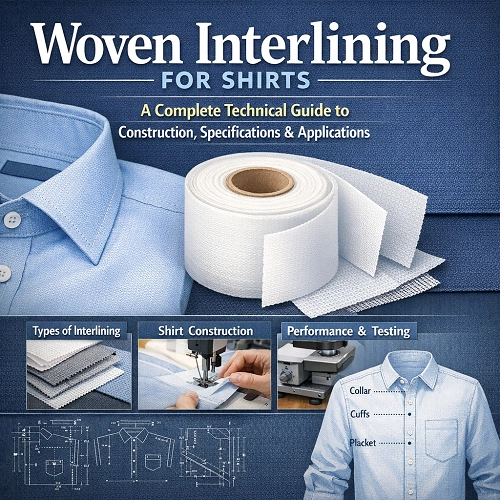
The following table presents the complete product range of the Plain Fabric Series 7 as supplied by Jiaxing Rainbow (UBL) Interlining Co., Ltd. All products share a 100% polyester base cloth, double dot PA coating, plain 1/1 weave, and a standard width of 60 inches (approximately 152 cm). Fusing conditions are uniform across the range: temperature 120–140 °C, time 12–15 seconds, pressure 1.5–2.5 kg/cm².
| Product Code | Weight (g/m²) | Width | Base Cloth | Coating | Weave Spec (D) | Weave Structure | Typical Shirt Application |
|---|---|---|---|---|---|---|---|
| H7190 | 14 | 60" | 100% Polyester | Double Dot PA | 10D × 10D | Plain 1/1 | Ultra-light collar facing, fine lawn shirts |
| H7191 | 17 | 60" | 100% Polyester | Double Dot PA | 15D × 5D | Plain 1/1 | Lightweight collar interlining, silk shirts |
| H7292 | 22 | 60" | 100% Polyester | Double Dot PA | 20D × 20D | Plain 1/1 | Collar stand, light cotton shirts |
| H7293 | 25 | 60" | 100% Polyester | Double Dot PA | 20D × 30D | Plain 1/1 | Collar, placket — cotton/polyester blends |
| H7391 | 28 | 60" | 100% Polyester | Double Dot PA | 30D × 30D | Plain 1/1 | Standard dress shirt collar & cuff |
| H7391M | 30 | 60" | 100% Polyester | Double Dot PA | 30D × 30M | Plain 1/1 | Collar — soft hand-feel requirement |
| H7392 | 26 | 60" | 100% Polyester | Double Dot PA | 30D × 20D | Plain 1/1 | Front placket, button band |
| H7393 | 30 | 60" | 100% Polyester | Double Dot PA | 30D × 30D | Plain 1/1 | Cuff, placket — medium-weight shirts |
| H7393M | 33 | 60" | 100% Polyester | Double Dot PA | 30D × 30M | Plain 1/1 | Double cuff (French cuff) interlining |
| H7395 | 36 | 60" | 100% Polyester | Double Dot PA | 30D × 50D | Plain 1/1 | Stiff collar, formal dress shirt |
| H7595 | 45 | 60" | 100% Polyester | Double Dot PA | 50D × 50D | Plain 1/1 | Structured collar band, corporate uniform shirt |
| H7596 | 53 | 60" | 100% Polyester | Double Dot PA | 50D × 75D | Plain 1/1 | Heavy cuff, waistband shirts |
| H7597 | 58 | 60" | 100% Polyester | Double Dot PA | 75D × 75D | Plain 1/1 | Reinforced placket, wind coat front |
| H7556 | 65 | 60" | 100% Polyester | Double Dot PA | 75D × 75D | Plain 1/1 | Medium-heavy shirt yoke, jacket inner |
| H7557 | 75 | 60" | 100% Polyester | Double Dot PA | 75D × 75D | Plain 1/1 | Stiff collar stand, tailored shirt collar |
| H7558 | 85 | 60" | 100% Polyester | Double Dot PA | 75D × 100D | Plain 1/1 | Heavy-duty cuff, formal shirt waistband |
| H7559 | 95 | 60" | 100% Polyester | Double Dot PA | 100D × 100D | Plain 1/1 | Structured front panel, overcoat body |
| H7560 | 105 | 60" | 100% Polyester | Double Dot PA | 100D × 150D | Plain 1/1 | Heavy structured collar, wind coat |
| H7561 | 115 | 60" | 100% Polyester | Double Dot PA | 100D × 150D | Plain 1/1 | Overcoat, suit front — heavier garments |
| H7562 | 125 | 60" | 100% Polyester | Double Dot PA | 100D × 200D | Plain 1/1 | Heavy outerwear, reinforcement applications |
| H7556B. M | 70 | 60" | 100% Polyester | Double Dot PA | 75D × 75D | Plain 1/1 | Medium-body interlining, fashion shirts |
| H7558B. H | 90 | 60" | 100% Polyester | Double Dot PA | 100D × 150D | Plain 1/1 | Heavy-body, formal shirt collar & cuff |
| H7561B. H | 120 | 60" | 100% Polyester | Double Dot PA | 100D × 250D | Plain 1/1 | Maximum-structure panel & front parts |
| Note: Due to the wide variety of fabrics used in the apparel industry, testing of interlining with specific shell fabrics and fusing equipment is recommended before full production. Source: interlining-factory.com/plain-fabric-series-7 | |||||||
All 23 product variants share a standard 60-inch width, 100% polyester base, and double dot PA coating.
Achieving a durable, bubble-free bond between the woven interlining and the shirt shell fabric requires precise control of three interdependent fusing parameters: temperature, time, and pressure. The following table provides the standard operating window for Plain Fabric Series 7 along with practical guidance.
| Parameter | Standard Range | Notes |
|---|---|---|
| Temperature | 120 °C – 140 °C | Upper platen temperature. Adjust down for heat-sensitive fabrics (silk, fine lawn). |
| Time | 12 – 15 seconds | Dwell time under pressure. Shorter dwell requires higher temperature — test before production. |
| Pressure | 1.5 – 2.5 kg/cm² | Even pressure distribution is critical. Verify platen flatness regularly. |
| Cooling | Cool flat, 30–60 sec | Allow bonded panel to cool flat before stacking or cutting to prevent delamination. |
| Fabric pre-treatment | Pre-shrink, clean surface | Shell fabric must be free of silicone finishes, wax, or excess moisture. |
| Defect | Probable Cause | Corrective Action |
|---|---|---|
| Bubbling / delamination | Insufficient temperature or time; moisture in fabric | Increase temperature to 135–140 °C; pre-dry fabric; extend dwell time |
| Strike-through (adhesive on face) | Excessive temperature or pressure; porous shell fabric | Reduce temperature; use release paper; switch to lighter-weight interlining |
| Stiff hand-feel | Over-fusing or wrong product selection | Select lighter grade (e.g., H7191 or H7292); reduce pressure |
| Uneven bonding | Worn or uneven platen; inconsistent pressure | Service press equipment; check platen flatness |
| Shrinkage mismatch | Shell fabric and interlining shrink at different rates | Pre-shrink both components separately before fusing |